
Updated: 2 months ago
If you’re looking for simple ways to save paper at home, this is where my journey began.
A few years ago, I started exploring how to reduce paper use in our daily life. What began as a practical effort gradually became part of something larger— my journey towards greener living, a journey that has slowly shaped how I travel, live, and think about what truly matters.
I had already started to recycle paper more effectively, but I knew our family could take it a step further.
Quick Summary: Easy Ways to Save Paper at Home
- use both sides of every sheet of paper,
- reuse packaging and scrap paper for drawings or notes,
- buy second-hand books when possible,
- choose recycled printer paper,
- avoid unnecessary receipts and paper tickets,
- print only when truly necessary and use double-sided printing,
- use reusable alternatives such as handkerchiefs,
- replace paper notes and lists with reusable boards or digital tools,
- and focus on progress rather than perfection.
Why to go beyond recycling paper
Recycling paper is an important step. As highlighted by The 1 Million Women blog post on how to save paper, “each tonne of paper that is recycled saves almost 13 trees, 2.5 barrels of oil, 4100 kWh of electricity, 4 cubic metres of landfill and 31, 780 litres of water.”
And yet, paper cannot be recycled infinitely.
As Audrey Holmes explains, paper is made up of long fibers that shorten each time they are recycled, making further reuse increasingly difficult. In practice, most paper can only be recycled five to seven times.
This was a humbling realization for me.
Especially when I learned that producing one tonne of paper requires around 20 mature trees—and that the average American uses the equivalent of about seven trees each year in paper and related products, as discussed by Dawn Cifford.
Easy Ways to Save Paper at Home: Where to Start
As usual, I began by taking stock of what we were already doing. We have a sign on our mailbox asking not to receive publicity materials—and, fortunately, it is mostly respected. We also started wrapping gifts more creatively since last Christmas, and we have bought recycled toilet paper since we started eco-friendly shopping. We also made a habit of using notebooks until they are completely filled.
During those weeks at home, we introduced a few more small changes—our own easy ways to save paper in everyday life.
Reuse Every Sheet of Paper
Thanks to this period, we began making a conscious effort to use both sides of every sheet of paper. It is such a simple change, yet it significantly reduces paper waste.
Without a doubt, the most eco-friendly among us is my five-year-old son, Max. From the very beginning of my “going green” journey, he has been my biggest supporter—and often my role model.
Each time he opens something, he carefully observes the packaging and immediately suggests how it could be reused. One day, he even ran to the recycling bin and started pulling out pieces of paper and cardboard, insisting they could be used again—for drawings, for crafts, for anything but waste.
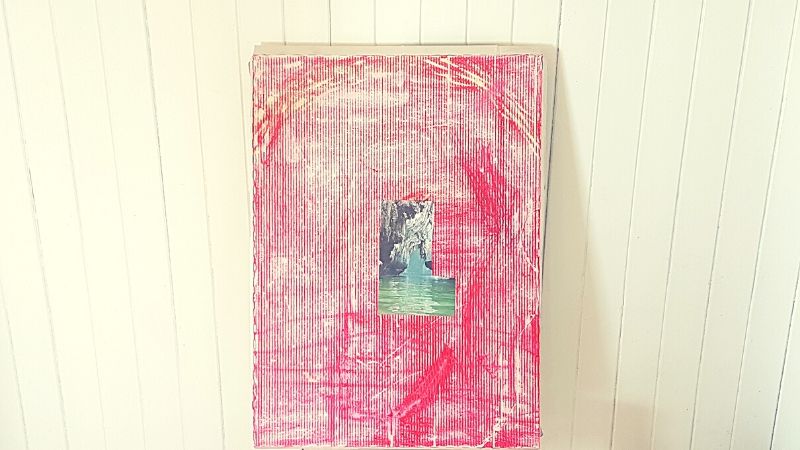
One of his creations was a painting made on the cardboard packaging of a photo frame.
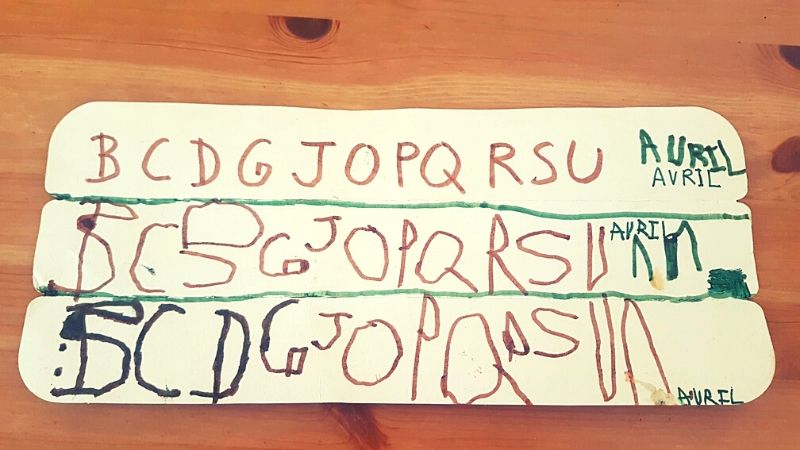
Below is a cardboard packaging that was around pizza dough that we bought. When Max saw it in the recycling bin, he was not happy and said this could be used again.
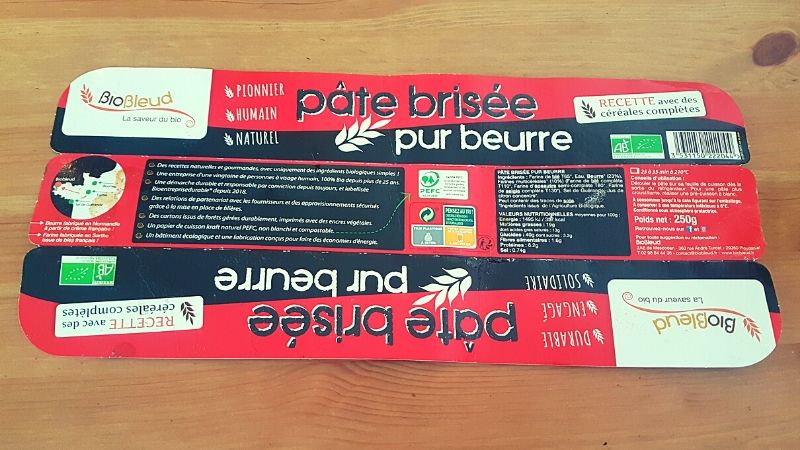
And he decided to use the other side of this paper to do his lockdown homework.
Buy secondhand books
I had occasionally bought used books from Amazon for years. Mostly, though, for financial reasons. Last Christmas we took this to another level by purchasing secondhand books as Christmas gifts for the first time. I also bought secondhand children’s books on ecology for my kids as part of greener parenting. In general, in case the new and the used had the same price, I used to have the tendency to go for the new one. Lately, however, I have decided to check whether a secondhand version is available prior to buying ANY book. If the secondhand book is almost the same price, I would buy that one. And I only buy a book after I’ve thought through whether I really need to OWN it. I will check that it is not available, for instance, at my local library.
With my little musketeers and ongoing training, I unfortunately do not have much time to read for pleasure these days. When they are older and more independent, I will consider buying a second hand e-reader. Another step towards saving more paper .
Buy recycled paper for printer
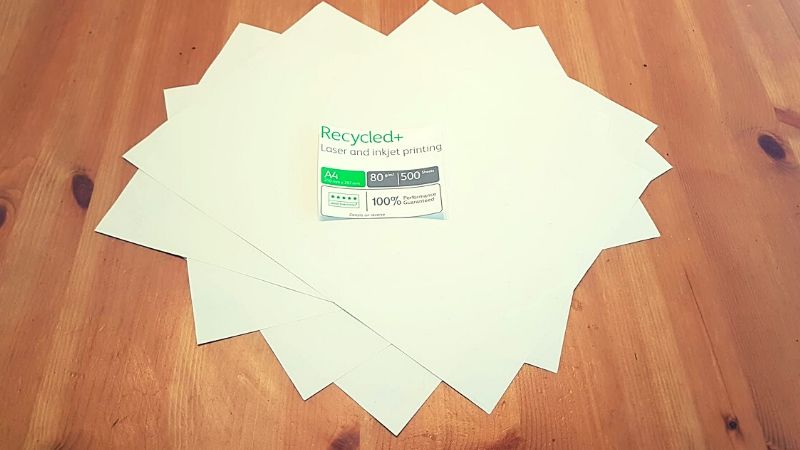
This was not a habit we had until last week, although among important easy ways how to save paper at home. Previously, our choice of printer paper was mostly informed by quality, along with technical, logistical, and financial parameters. These did not lead us to buy recycled paper. Now, we have decided to try out recycled paper to save paper. We ordered this Xerox paper that is made from recycled materials:
Say no to shopping tickets to save paper
My tendency was to respond in the shops and cafés that I do need the shopping ticket whenever I was asked if I wanted one. Yet I did not have the habit of saying myself each time, PRIOR TO paying, that I do not need the ticket. And half of the time, the ticket still got printed for nothing anyway, increasing paper waste. Indeed, sometimes the tickets are important to be printed, as they also represent a guarantee. Or in case I might need to return or exchange something I’ve purchased. Yet in many cases, the shops now have electronic systems for these situations.
When I buy food in a shop or pay a bill in a restaurant, I certainly could always say that I do not need a ticket in order to save paper. This habit has not been so easy to introduce. It still sometimes happens that I remember too late… Progress not perfection!
Only print if really necessary, and print on both sides
“Think before you print,” states Dawn Cifford and many others writing on saving paper. I already had started several years ago to become more conscious about paper waste when it came to printing. For instance, particularly at home, I reduced font sizes and changed the margins when I really needed to print something with many pages. But sometimes I printed things that were not essential to print. Like flight tickets and maps. Now, I have decided to opt only for electronic versions of these materials.
As embarrassed as I am to admit it, my home computer was not configured to print two-sided as a default setting. First, for many years I thought that the printer we have (that my husband owned before we met) was too old to be able to print two-sided  I figured out lately that it does print very well on both sides. Yet I forgot to check my printer setup. It was only last week that two-sided default printing was installed on my computer.
Use handkerchiefs to save paper at home
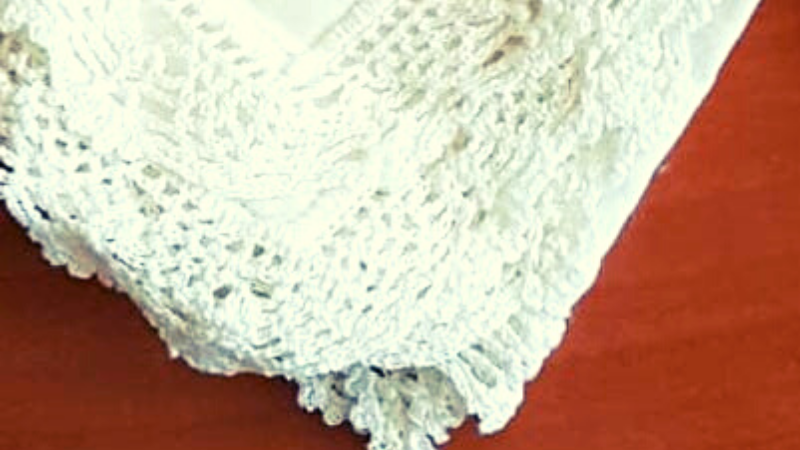
Handkerchiefs were part of my childhood in the Soviet Union. Yet with the end of Soviet Union, the habit of using handkerchiefs also faded for many people in my country. Using handkerchiefs instead of tissues is on the list of 30 ways to save paper put together by Dawn Cifford. Before looking to buy or make myself some handkerchiefs, I called my mother. I was wondering if she still had some handkerchiefs saved from the time when they were commonly used. She did, and she promised to send these for me to start with. One is also presented on the featured photo (photo credit: Viive Talviste).
During this time of pandemic, some may argue that using handkerchiefs is not a sanitary solution. However, I think much comes down to HOW you use and wash them. As is the case with the DIY cloth face masks that many people are currently using. In case of doubt, many recommendations for how to sanitize handkerchiefs are available online.
Use erasable board and phone for notes and lists
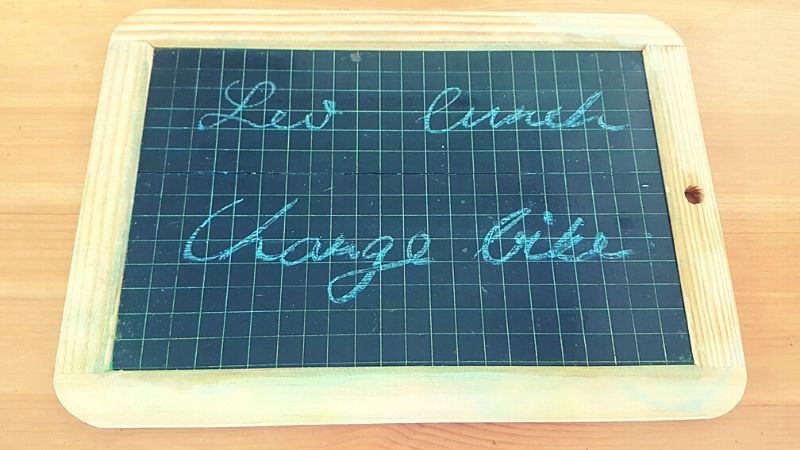
This is another simple way how to save paper at home. Be it the white or black board, this could be a great solution to reduce paper use (e.g. post-its). We have a little black board, presented in one of the featured photos. And some chalk that Santa Claus brought to the kids, and I have decided to use this whenever possible instead of post-its.
Sabiha Sultana outlines 15 best apps for shopping lists for Android. I decided to pick the first one, Out of Milk, to give a try. I love handwriting, but let’s see if I manage to cultivate digital shopping lists as a permanent habit. For sure, I am not ready to give up journaling by hand yet!
Reflections from 2026
It is interesting to look back and compare my habits today with those of six years ago. Some have truly anchored themselves in my life. When I can, I always buy second-hand books. I print even more rarely now and almost never take a shopping receipt—only when I think I might need to return something.
Part of this shift is not just personal discipline, but also how the world has evolved. Life today seems to ask us to print less, and many shops now default to no receipt unless you request one. It makes certain changes easier to sustain.
We also try to use paper fully—though not always perfectly. Some days, my three-year-old daughter insists on a fresh sheet for her drawings, even when there is perfectly good paper from the day before. These small moments remind me that sustainability is often negotiated in real life, not ideal conditions.
There are also habits that did not stick. I never quite adopted handkerchiefs, and I still do not use my phone for lists. My shopping lists are usually just whatever scrap of paper happens to be nearby.




What a person must seek in his relationship with nature. It is not complete domination over it, but rather a method and method of living derived from the ethics of preserving the environment and understanding with something that was before us and will continue after us.
Richard Weaver
Thank you Tria for your comment! Beautifully said and I agree with this thought!
Love the kids story about using paper like cardboard, beautiful kids creativity and ingenuity 🙂
Thanks Jim! Yes, kids are incredible, their creativity and perspective continues to amaze me!
Kids seem to like the pile of (re-used) paper from stuff the adults previously printed and did not need anymore, to draw freely, and one advantage is that paper can be freely/easily available while we typically keep the “clean” paper completely hidden and they have stopped asking for it completely. Those simple tips save a lot of paper, thanks again for sharing & implementing!
Thanks Jim for your kind feedback and for your support!
Good😊
Thank you Viive for a sweet comment!
Thank you for sharing. I appreciated your thoughtful perspective on mindful living and the reminder that small, intentional choices can create meaningful change over time.
Thanks Susye for your supportive comment and I am glad that you found the post to be a useful reminder!
I just love paper. I collect it, save it and spend a lot of time looking at it. Thank you for sharing your tips. There is something here for everyone and it means that my paper supply is safe.
Thank you for this lovely comment! I completely understand the love of paper — there is something so tactile, comforting, and beautiful about it. I do not think sustainability has to mean giving up the things we genuinely cherish, but rather learning to enjoy them a little more consciously and intentionally. I am so glad the post felt balanced and that your beloved paper collection remains safe.