
Updated: 41 seconds ago
Before I ever visited, the Maldives existed in my mind in two rather different versions.
For my friends in Switzerland and France, it was the ultimate honeymoon destination: impossibly blue water, white beaches, and luxurious bungalows standing on stilts above the sea.
For my humanitarian friends, it was something else. Some escaped there for a few precious days of R&R while posted in more difficult parts of Asia. Others, working in international development, were lucky enough to be posted to Malé itself. The Maldives, a little like Fiji, always struck me as one of those places where getting sent there for work sounded suspiciously like winning the humanitarian-posting lottery.
So long before I visited, I thought I knew what the Maldives looked like.
Tiny islands scattered across the Indian Ocean. Atolls. Seaplanes carrying newlyweds to remote resorts. Water in shades of blue that never quite look real in photographs. And those rows of overwater bungalows that have become almost shorthand for paradise.
What I knew much less about was the country underneath all that blue.
Arrival by seaplane
We did arrive by seaplane, and it was special.
Having travelled to more than 90 countries and flown on planes of pretty much every size, I didn’t expect the seaplane itself to impress me that much. Yet it did. I was like a little girl, ridiculously excited.
It reminded me of seeing giraffes and elephants for the first time on safari in Kenya. Or diving for the first time in Egypt. Or taking my first-ever helicopter flight in Pakistan. There are some experiences that somehow break through all the travelling you have already done and make you feel like a beginner again.
I kept tapping my husband on the arm: “Look at this one! And this one!”
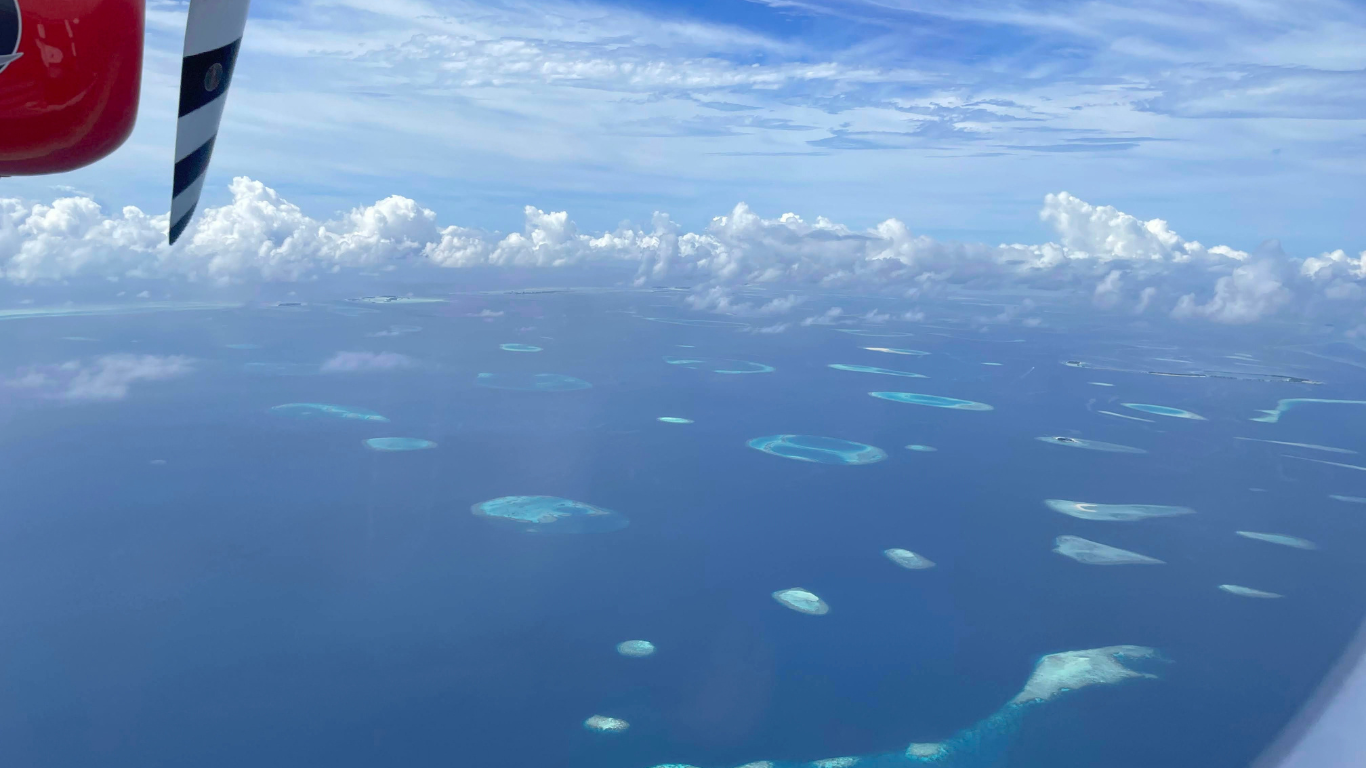
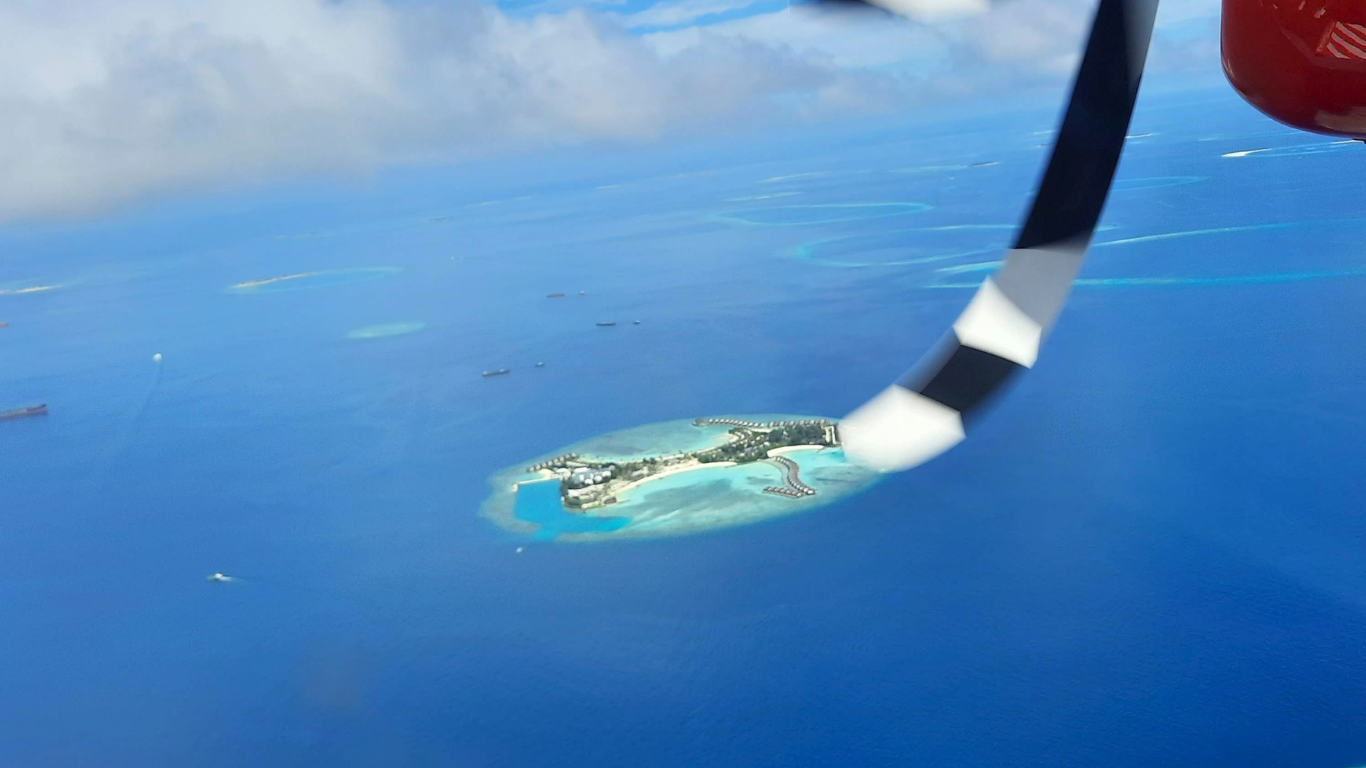
Because the atolls really are extraordinarily beautiful from above—little rings and splashes of turquoise scattered across the vast, deep blue of the Indian Ocean. I had seen countless photographs of them before. But looking down at them through the window of that tiny seaplane was completely different.
Songkran Celebration
Sometimes you travel to one country and unexpectedly end up learning about another one as well. It happened to me in France, where, in many ways, I first really discovered Morocco. And it happened again on our very first day in the Maldives.
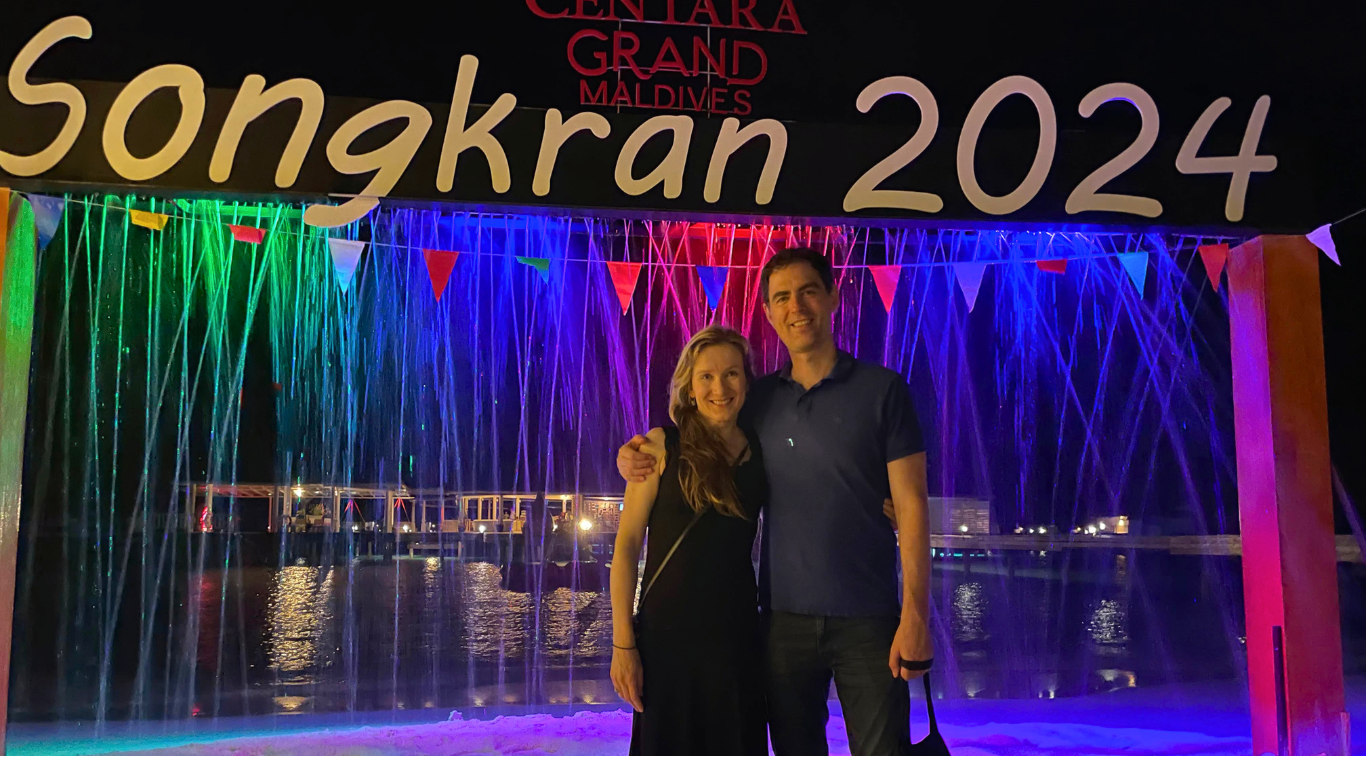
We arrived right in the middle of Songkran—the Thai New Year celebrations.
I had been to Thailand before, but never during Songkran. I knew about the famous water fights and had seen plenty of videos of people enthusiastically soaking complete strangers in the streets. What I certainly didn’t expect was to experience my first Songkran on a tiny island in the Maldives.
We were lucky: our resort was Thai-owned, and they had brought the celebration to the island. There was something wonderfully unexpected about experiencing this very Thai tradition surrounded by the turquoise waters of the Indian Ocean.
And while the water fights were fun, what I particularly loved was the Thai dance performance, watching the dancers move in their beautiful traditional costumes.
I love this about travelling and living abroad: cultures don’t always stay neatly within national borders. Sometimes you discover Thailand in the Maldives—or Morocco in France.
Snorkeling
Before going to the Maldives, I remember asking friends who had been there how they could possibly spend an entire week on such a tiny island.
“But what did you do all day? Didn’t you get bored, unable to go anywhere?”
They told me they went diving every day. The Maldives, they said, was paradise for watersports.
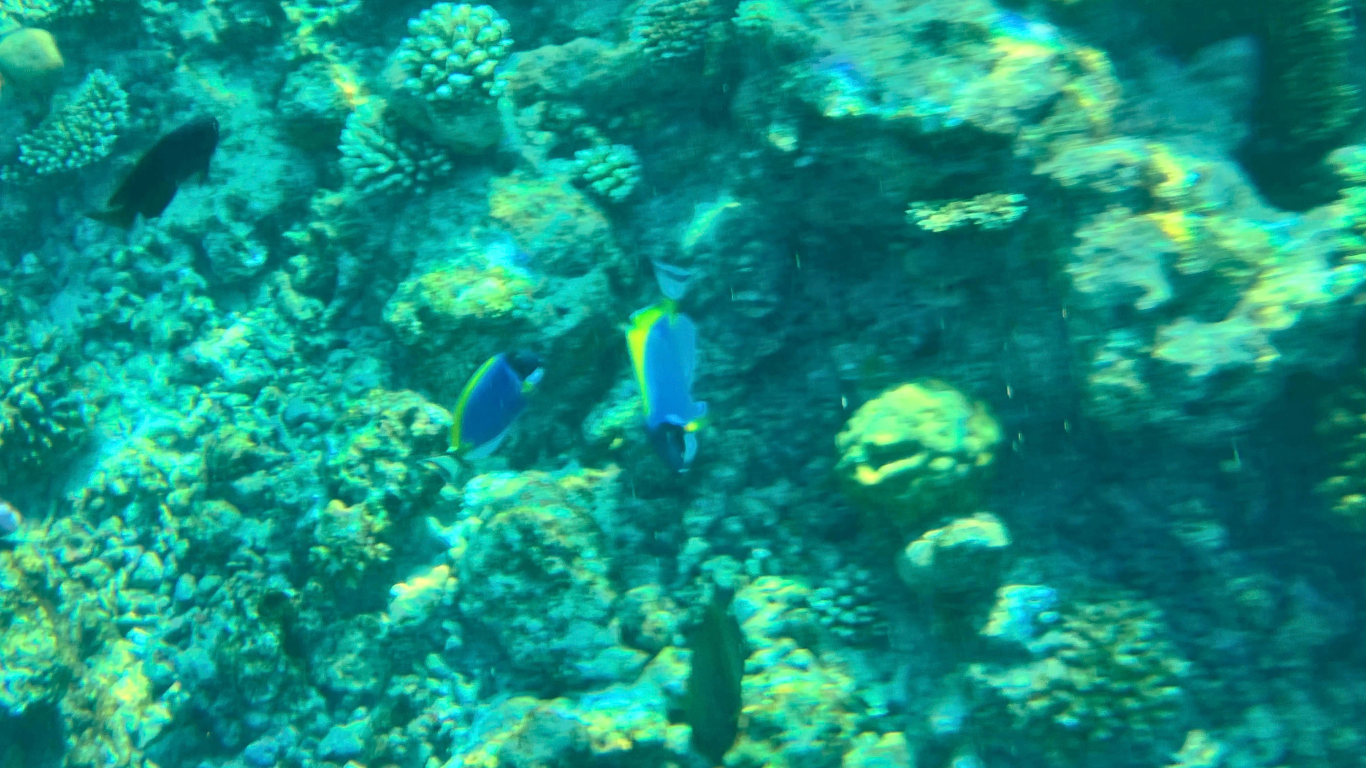
My husband doesn’t like diving, so for us it was snorkeling. And we did it every day.
What made it extraordinary was that our bungalow stood directly over the water, with corals just below us. There was no need to walk to a beach or take a boat somewhere. We simply opened the door, stepped down from our bungalow, put on our masks and disappeared into another world.
That was perhaps the most magical part: realizing that while you are sleeping, there is this entire hidden world beneath you—corals, colorful fish and other sea creatures going about their lives just a few meters below your bed.
Every room even came with snorkeling equipment as part of the standard amenities. A bathrobe, slippers, a spare toothbrush—and your mask, snorkel and fins.
In the Maldives, apparently, they are all equally essential.
Fifty Shades of Blue, Sunrises and Sunsets
The photos you see of the Maldives do not lie. The sea really does come in an almost unbelievable number of shades of blue.
I have been impressed by the color of the water in Mexico, Barbados and Bali, but the Maldives was on another level. Perhaps it is because here the sea is the dominating element. Everything else—the islands, the buildings, even the people—seems tiny in comparison. In other places, the land and everything happening on it somehow compete with the sea for your attention. In the Maldives, the sea has the stage almost entirely to itself.
And then there are the sunrises and sunsets.
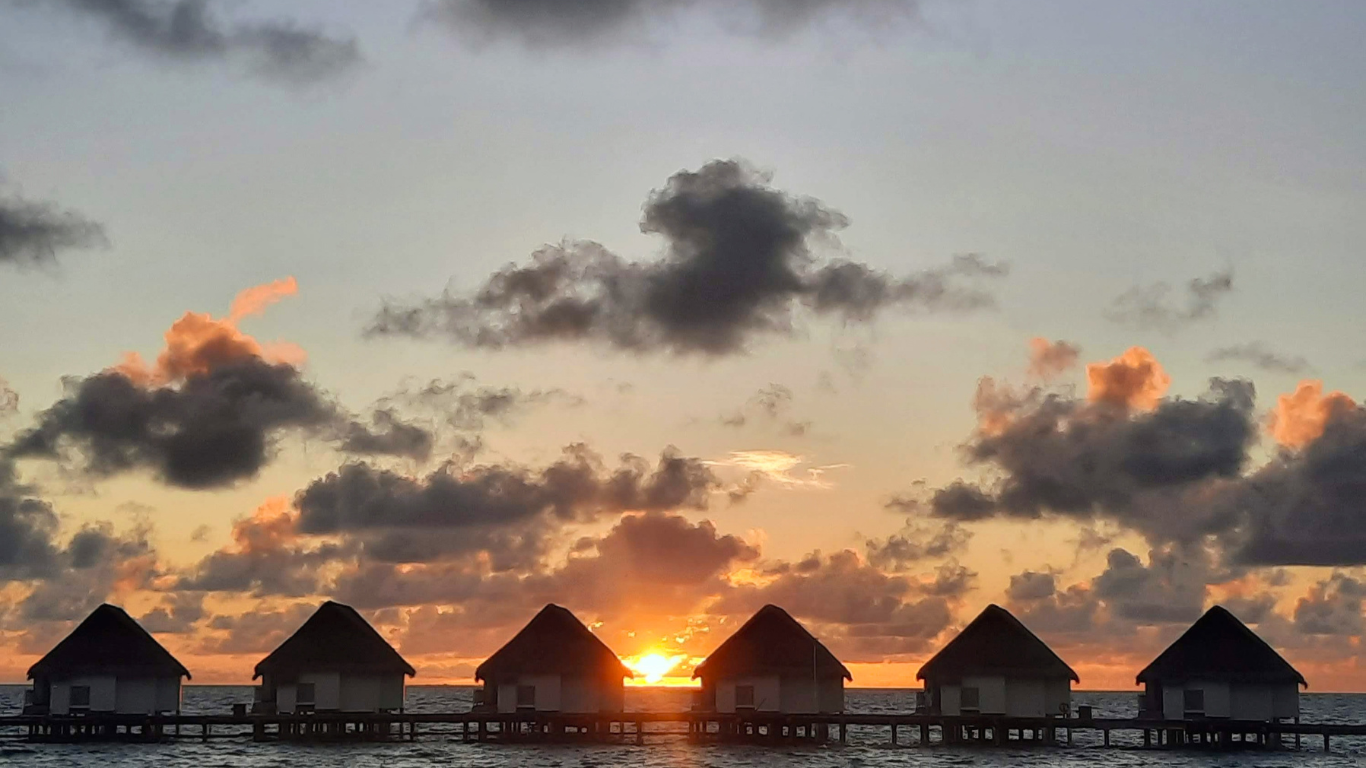
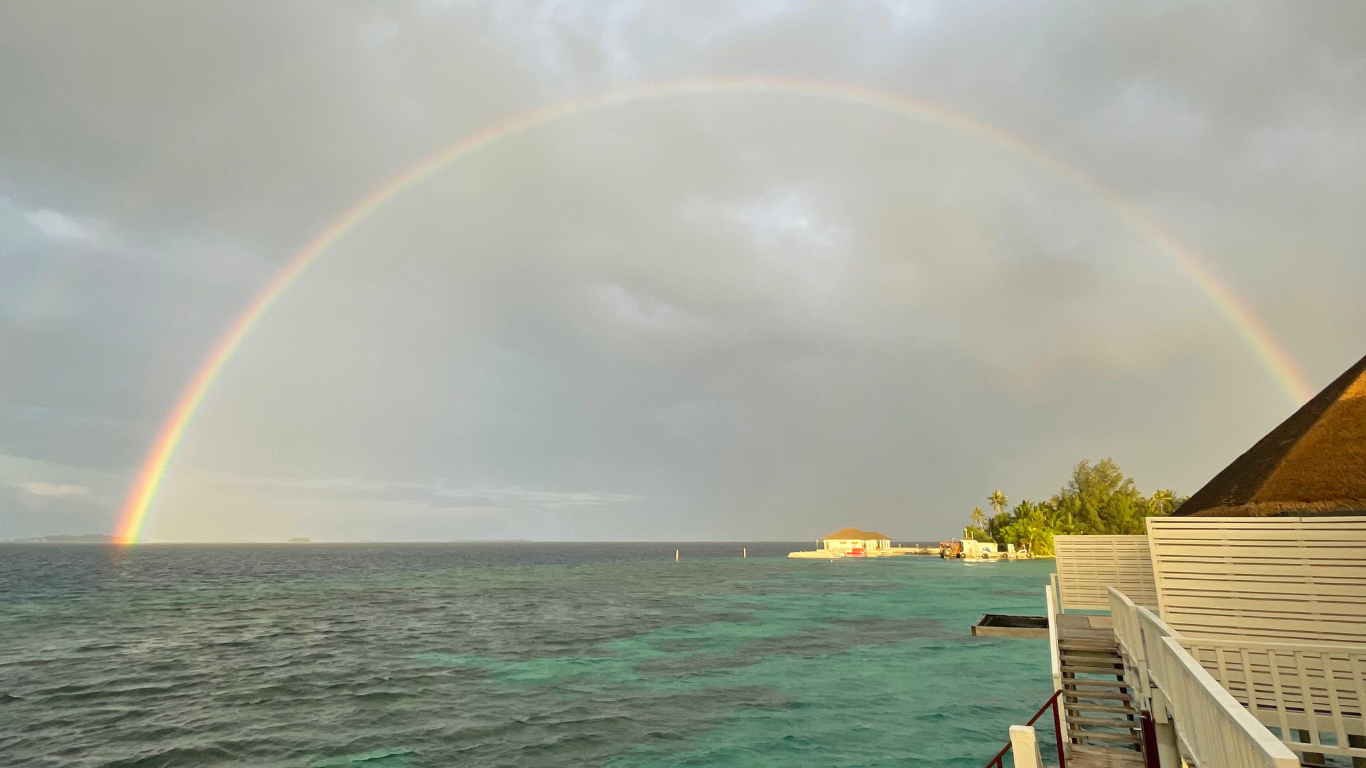
Watching them in the Maldives feels a little like watching a sunset from a boat. There is simply nothing between you, the sky and the sea. Maybe a few clouds. Sometimes a rainbow.
And because there is so little to obstruct the horizon, you can occasionally see the rainbow in its entirety, one end seemingly touching the ocean and the other disappearing back into it. It is something surprisingly rare to see when you spend most of your life on land.
More Hidden Facets of the Maldives
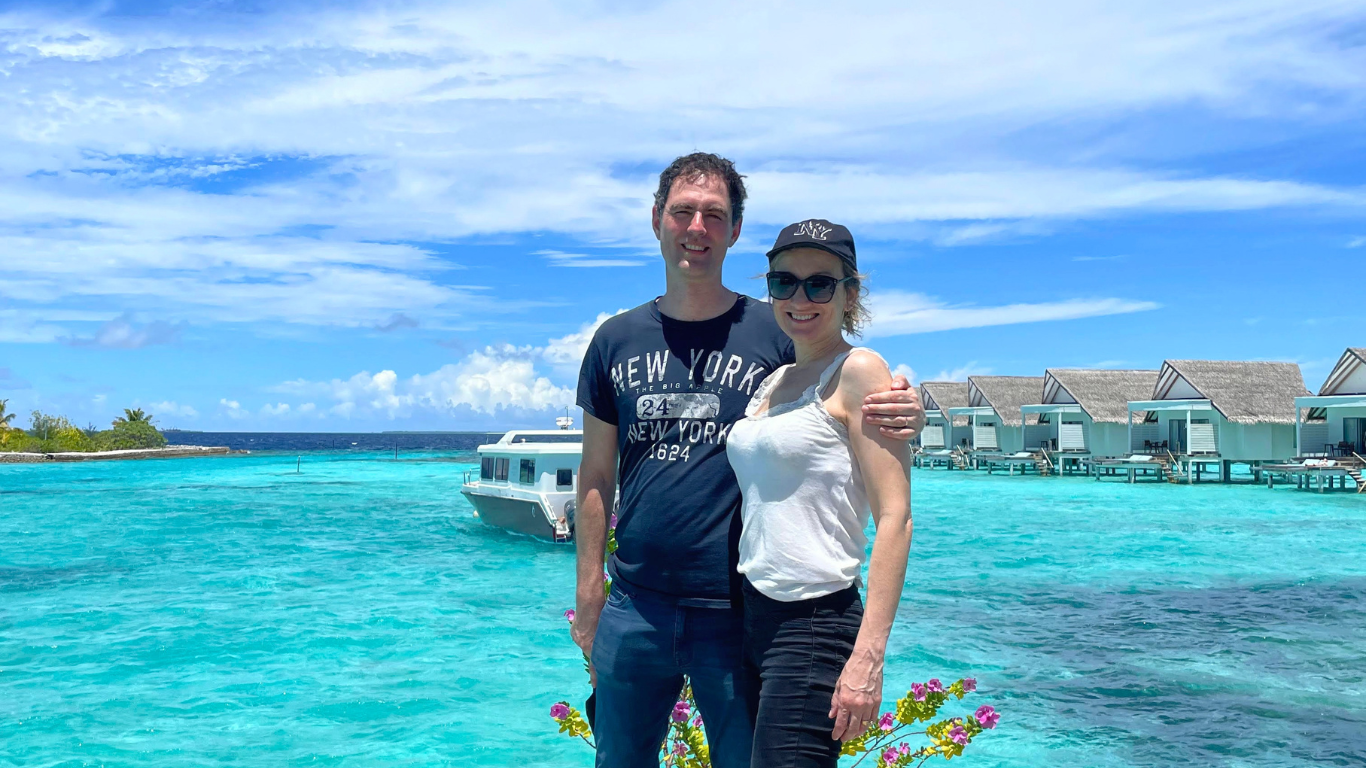
During our stay, celebrating our tenth wedding anniversary, my only real glimpse behind the carefully polished world of the resort came through conversations with the people working there.
Nobody actually lived on our tiny island. You could walk from one shore to the other in about five minutes, and the entire island belonged to the resort. Most of the people working there whom I spoke with were migrant workers from other countries of the Global South. I met only a few Maldivians who came from nearby inhabited islands.
And gradually, I became more conscious of the two very different worlds existing on that tiny patch of land.
There we were—including me—being thoroughly spoiled. Beautiful rooms. Elaborate meals. Someone cleaning, cooking, carrying, serving and making everything appear effortless. Behind that experience were people working extremely hard, sometimes six days a week. Through gaps in the palm trees and lush vegetation, you could occasionally glimpse the much more modest accommodation where resort staff lived. Sharing rooms, I learned, was not unusual.
I had felt something similar in Bali, and it also made me think of cruise ships: the extraordinary contrast between the people consuming luxury and the people whose labor makes that luxury possible.
The Uneasy Side of Luxury
Perhaps what unsettled me most was how carefully separated the two worlds seemed to be. The beautiful side was designed to be seen. The other one largely wasn’t.
It made me uncomfortable.
Was this exploitation? I didn’t know enough about people’s salaries, contracts, working conditions or their own views to make such a judgment. But I could see the inequality. And somehow, surrounded by all that carefully constructed perfection, it felt particularly stark.
In Europe, wealth and poverty exist too, of course, but there are countless gradations between them. Here, on this tiny resort island, the contrast seemed almost compressed: people who could afford to fly across the world to spend a week in extraordinary luxury, and people who had travelled across borders to work long days making that experience possible.
The more carefully inequality is hidden from view, I sometimes think, the more unsettling it becomes.
It left a slightly bitter aftertaste to an otherwise magical experience. More importantly, it made me turn the question back on myself. I was on the privileged side of this equation.
So what was within my power as a traveller? Was leaving generous tips enough? Probably not.
But what else could I do?
Why Does the UN Work in Paradise?
All of this also made me think about something else.
I have had friends and colleagues who were posted to Malé with international development organizations. And looking around at this apparent paradise, you might reasonably wonder: what exactly does the UN do in the Maldives?
Quite a lot, as it turns out.
The Maldives is extraordinarily vulnerable to climate change. Around 80 percent of its islands are only about one meter above sea level. Rising seas, coastal erosion, changing rainfall and increasingly extreme weather threaten not only beaches, but homes, infrastructure, freshwater supplies and people’s livelihoods.
And those magnificent coral reefs we were snorkeling above are not simply something beautiful to admire. They are ecosystems on which the country depends, and they are increasingly threatened by warming seas, pollution, erosion and other pressures.
Then there is energy. Keeping hundreds of scattered islands running requires enormous amounts of energy, while the country remains heavily dependent on imported fossil fuels. Part of the UN’s work is therefore helping the Maldives expand renewable energy and find ways of financing that transition.
But the challenges are not only environmental.
The Maldives also faces questions of inequality, opportunities for young people and women, and the conditions of its large migrant workforce. Reading about this after our trip made me think again about the conversations I had with resort workers. What I had glimpsed from the privileged side of one tiny island was part of a much bigger and more complicated picture.
What Can We Do as Travellers?
I kept coming back to the question I had asked myself at the resort: beyond leaving generous tips, what could I actually do differently?
Perhaps the answer is not to stop coming to places like the Maldives, or even to feel guilty about enjoying them. But we can be more curious about where our money goes. We can look at how resorts treat their staff and what they do for the surrounding communities and environment. We can eat locally produced food, buy from local businesses and choose locally run excursions where possible.
And perhaps most importantly in the Maldives, we can venture beyond the private resort islands. Staying for at least part of a trip in a guesthouse on an inhabited island means experiencing a very different Maldives—and allowing more of what we spend to remain within local communities. Community-based tourism is something the Maldives itself, together with UNDP, has been trying to develop as a more inclusive form of tourism.
I didn’t do this on that trip. We stayed on our beautiful little resort island and enjoyed it enormously. But if I return to the Maldives, I would like to see the other side too.
Perhaps that is what I ultimately took away from the Maldives.
It really is as beautiful as the photographs suggest. The water really is that blue. The islands really can feel like paradise.
But paradise is a tourist’s perspective.
A country is always more complicated.
Leave A Comment